For organizations still running Cisco Nexus 93180YC-EX or 93108TC-EX switches, the most important lifecycle date may not be the one in 2027.
It is November 7, 2026.
That is Cisco's published End of Service Contract Renewal Date for these Nexus 9000 models. After that date, customers can no longer extend or renew Cisco service contracts for the affected hardware. Cisco's final Last Date of Support follows on August 31, 2027.
For infrastructure teams, this creates a decision point.
Do you refresh switches that may still be meeting the technical requirements of your environment? Renew Cisco support while the option remains available? Or extend the useful life of the hardware with an alternative support strategy while you plan a larger network, data center, or cloud initiative?

The answer should depend on your infrastructure roadmap, not simply the date printed on an OEM lifecycle notice.
Cisco Nexus 93180YC-EX and 93108TC-EX End-of-Life Dates
Cisco announced the end-of-sale and end-of-life process for the Nexus 93180YC-EX and Nexus 93108TC-EX in 2021.
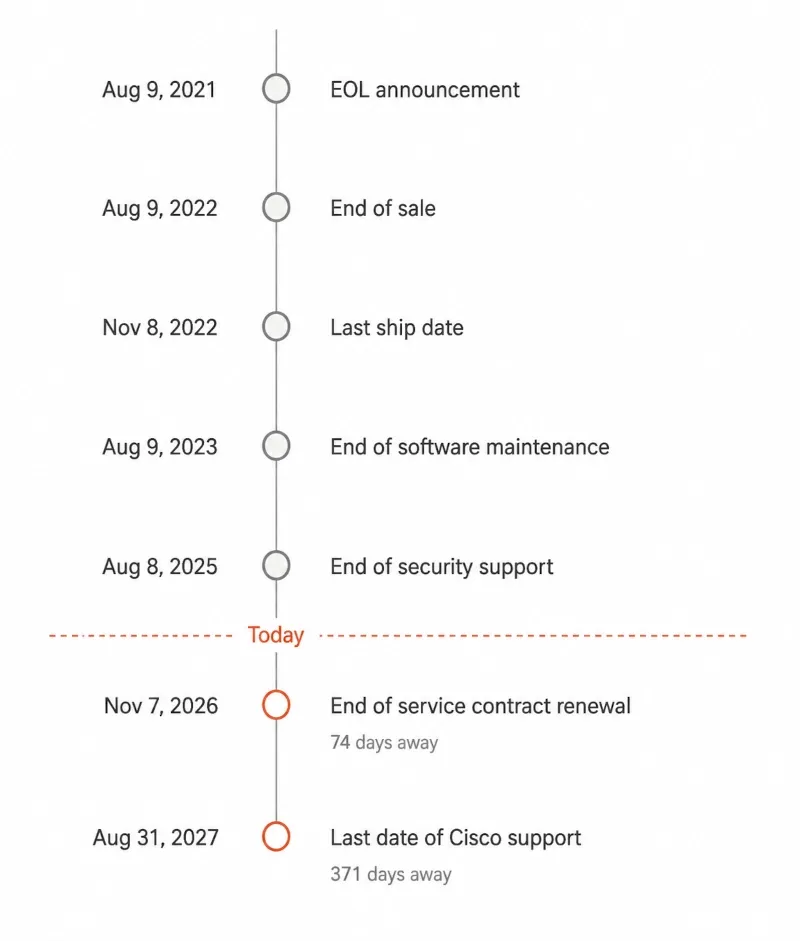
Here are the key dates organizations running these switches should know:
| Lifecycle Milestone | Date |
|---|---|
| End-of-Life Announcement | August 9, 2021 |
| End of Sale | August 9, 2022 |
| Last Ship Date | November 8, 2022 |
| End of Software Maintenance Releases | August 9, 2023 |
| End of Vulnerability/Security Support | August 8, 2025 |
| End of Service Contract Renewal | November 7, 2026 |
| Last Date of Cisco Support | August 31, 2027 |
Cisco defines August 31, 2027 as the final date customers can receive applicable support under active service contracts or warranty terms. After that date, Cisco considers the affected products obsolete and its support services are no longer available.
ReluTech Lifecycle Analysis
As of August 25, 2026, organizations have only 74 days remaining before Cisco's service-contract renewal deadline for the Nexus 93180YC-EX and 93108TC-EX.
There are still 371 days until Cisco's final hardware support date.
That creates a 297-day gap between the last opportunity to renew Cisco support and the actual end of Cisco support.
In other words, a Cisco Nexus support decision that looks like a 2027 problem is actually a 2026 planning decision.
Organizations that wait until next year to evaluate their options may discover that one of those options has already disappeared.
Why Cisco Nexus 9000 End of Support Matters
The Nexus 9000 family is designed for data center networking, and the 93180YC-EX and 93108TC-EX can occupy important positions within the network infrastructure connecting servers, storage, virtualization platforms, applications, and other systems.
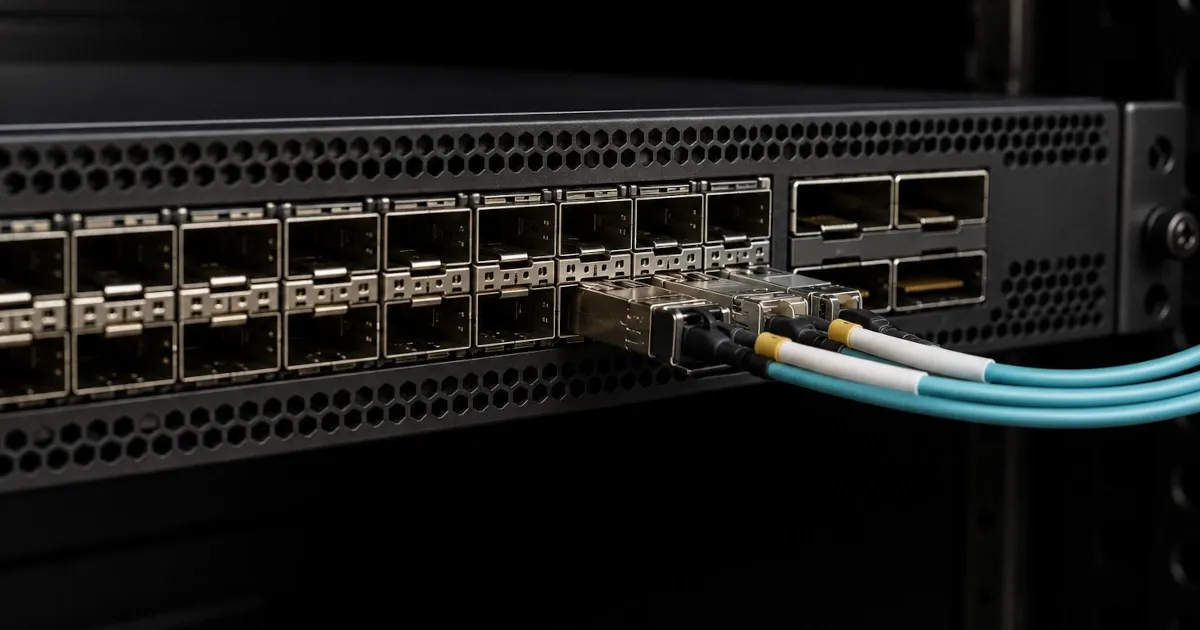
The Nexus 93180YC-EX, for example, provides:
- 48 1/10/25-Gbps ports
- Six 40/100-Gbps uplink ports
- Up to 3.6 Tbps of bandwidth
- Support for NX-OS and Cisco ACI deployments
The Nexus 93108TC-EX provides 48 100M/1/10GBASE-T ports along with six 40/100-Gbps uplinks.
For many organizations, these switches did not suddenly become technically incapable when Cisco announced their end of sale.
That distinction matters.
OEM lifecycle and useful equipment lifecycle are not always the same thing.
A switch can reach an OEM support milestone while still providing the capacity, connectivity, and reliability an organization requires.
The question becomes whether there is a business or technical reason to replace it now.
Does Cisco Nexus End of Support Mean You Have to Replace Your Switches?
Not necessarily.
End of support means Cisco's support relationship with the affected product is ending. It does not automatically mean the hardware stops functioning on August 31, 2027.
Before approving a large network refresh, infrastructure teams should evaluate several factors.
1. Is the current hardware creating a performance constraint?
If bandwidth, port density, latency, or other technical requirements have outgrown the existing Nexus environment, replacement may be justified regardless of lifecycle status.
But if the switches continue to satisfy the requirements of the workloads attached to them, EOSL alone may not be a technical reason to remove them.
2. Are newer capabilities required?
Cisco identifies the Nexus 93180YC-FX3 as a replacement for the 93180YC-EX and the Nexus 93108TC-FX3P as a replacement for the 93108TC-EX.
Organizations that need functionality available on newer platforms may have a strong reason to upgrade.
Organizations that do not may have more flexibility.
3. What are your software and security requirements?
This deserves separate consideration from hardware maintenance.
Cisco's scheduled vulnerability and security support milestone for the 93180YC-EX and 93108TC-EX passed on August 8, 2025. Cisco's software maintenance release milestone had already passed on August 9, 2023.
Third-party hardware maintenance does not restart Cisco software development, create Cisco security patches, or replace Cisco TAC entitlements.
Organizations considering extended hardware use should therefore evaluate hardware support and software/security requirements independently.
Security, compliance, NX-OS requirements, network architecture, and internal risk policies should all be part of the decision.
4. What else is changing in the data center?
This is often the bigger question.
If an organization expects to consolidate data centers, migrate workloads to the cloud, change its virtualization platform, modernize applications, or redesign its network over the next 12 to 36 months, replacing networking hardware immediately before another major infrastructure change can create unnecessary spending and additional work.
Extending the hardware lifecycle can create a bridge between today's environment and the environment the organization actually wants to build.
Three Options for Cisco Nexus 93180YC-EX and 93108TC-EX Environments
Organizations approaching the November 2026 and August 2027 deadlines generally have three paths.

Option 1: Renew Cisco Support Before the Deadline
Organizations that intend to continue using Cisco support should review covered assets now.
Cisco lists November 7, 2026 as the final date to extend or renew a service contract for these products.
Waiting until 2027 is not an option for organizations that want to make that renewal.
The downside is that renewing an OEM contract can commit additional budget to equipment that may already be approaching the end of your organization's planned lifecycle.
Option 2: Refresh the Nexus Environment
Replacing the switches may make sense when there is a clear technical, operational, security, or strategic requirement.
Cisco identifies newer FX3-series products as replacements for the affected EX models.
A refresh can be the right decision when the organization needs additional capabilities or when the refresh already aligns with a broader infrastructure modernization plan.
The key is distinguishing a needed refresh from a refresh driven primarily by the OEM lifecycle calendar.
Option 3: Extend the Hardware Lifecycle
If the existing Cisco Nexus switches continue to meet operational requirements, organizations may choose to maintain the hardware beyond the OEM support lifecycle.
Post-warranty hardware support can provide services such as:
- Remote hardware diagnosis and troubleshooting
- Replacement parts
- Field engineering
- Defined response-time SLAs
- Support for legacy or end-of-life hardware
- Multi-vendor infrastructure support
ReluTech provides networking hardware and ongoing maintenance support across Cisco Nexus and other enterprise networking platforms.
This approach can give infrastructure teams additional time to determine when and how the environment should actually be modernized.
When Extending Cisco Nexus Hardware Makes Sense
Extending the lifecycle of a Nexus 9000 environment can be especially useful when:
A data center exit is already planned. Replacing network equipment shortly before leaving the facility can result in capital being spent on infrastructure with a very short useful life.
A cloud migration is underway. Maintaining the existing network during migration can help organizations avoid making a major on-premises investment in an environment they are actively reducing.
A larger network redesign is coming later. Keeping functioning equipment supported can provide additional time to design the future architecture instead of rushing into an interim refresh.
The current switches still meet performance requirements. If there is no technical requirement to replace the platform, organizations can evaluate whether the refresh budget would deliver greater value elsewhere.
Multiple OEMs are approaching lifecycle milestones. A data center rarely contains only Cisco equipment. Servers, storage arrays, virtualization infrastructure, and network equipment often reach support milestones at different times. Extending selected assets can help synchronize refresh decisions around a larger modernization strategy.
The Cost of Treating Every EOSL Date as a Refresh Deadline
OEM lifecycle dates are important.
But treating every lifecycle event as an automatic replacement trigger can lead to a continuous cycle of infrastructure refreshes.
- A server reaches EOSL, so it gets replaced.
- A storage array reaches EOSL, so it gets replaced.
- A network switch approaches its support deadline, so it gets replaced.
Meanwhile, the organization may also be investing in cloud migration, application modernization, data center consolidation, or virtualization changes.
The result can be capital tied up in infrastructure the business ultimately intends to reduce or retire.
A different approach is to ask: how long does this equipment actually need to keep running?
If the answer is 12, 18, or 24 months, the support strategy should reflect that timeline.
The OEM roadmap does not have to become your infrastructure roadmap.
Hardware Support and Security Support Are Different
One important caution applies specifically to the Nexus 93180YC-EX and 93108TC-EX.
Cisco's end-of-vulnerability/security-support date has already passed.

That means an organization should not look at third-party hardware maintenance as a substitute for Cisco software development or security remediation.
Instead, infrastructure teams should separate the decision into two questions:
- Can we safely continue operating the software and configuration required by this environment?
- If the physical hardware fails, how will we diagnose, repair, or replace it?
Third-party maintenance can address the second question.
Your networking, security, and compliance teams still need to address the first.
That distinction allows organizations to make a more informed lifecycle decision without assuming either that every EOSL device must immediately be replaced or that hardware maintenance solves every lifecycle issue.
How ReluTech Can Help Extend Cisco Nexus Hardware Life
ReluTech supports Cisco Nexus networking hardware as part of its broader data center hardware and post-warranty maintenance capabilities.
Instead of beginning with the assumption that every end-of-life switch should be replaced, we can evaluate the environment around the organization's actual infrastructure plans.
That can include identifying:
- Which Cisco models are approaching support milestones
- Which devices still need OEM coverage
- Which hardware may be a candidate for post-warranty support
- Required response-time and parts availability
- Locations and quantities
- Expected retirement or migration dates
- Other server, storage, and networking hardware that can be consolidated under the same support strategy
For organizations moving toward cloud or data center consolidation, the goal is not simply to keep old equipment running forever.
It is to keep critical infrastructure supported for exactly as long as the business still needs it.
Don't Let the November 2026 Deadline Make the Decision for You
The final Cisco support date for the Nexus 93180YC-EX and 93108TC-EX is August 31, 2027.
But the more immediate deadline is November 7, 2026, when Cisco ends service contract renewals for the affected hardware.
That makes now the right time to inventory the environment and determine which switches actually need to be refreshed, which should remain with Cisco, and which may be candidates for extended hardware support.
Have Nexus 93180YC-EX or 93108TC-EX switches in your environment?
Send ReluTech your Cisco model list, quantities, locations, and current support requirements. We can help you determine where post-warranty support could extend the hardware lifecycle and give your team more control over when the next refresh happens.
Request a Cisco Network Support Assessment
Frequently Asked Questions
When does the Cisco Nexus 93180YC-EX reach end of support?
Cisco lists August 31, 2027 as the Last Date of Support for the Nexus 93180YC-EX. After that date, Cisco support services for the affected product are unavailable.
When does the Cisco Nexus 93108TC-EX reach end of support?
The Cisco Nexus 93108TC-EX also reaches its Last Date of Support on August 31, 2027.
What is the last date to renew Cisco support for the 93180YC-EX?
Cisco lists November 7, 2026 as the End of Service Contract Renewal Date for the Nexus 93180YC-EX and 93108TC-EX.
Has security support ended for the Cisco Nexus 93180YC-EX?
Cisco lists August 8, 2025 as the End of Vulnerability/Security Support date for the affected hardware. Cisco defines this as the final date that Cisco Engineering may release a planned maintenance release or scheduled software remedy for a security vulnerability.
Can I continue using a Cisco Nexus switch after EOSL?
Hardware does not automatically stop functioning when it reaches an OEM support deadline. Whether it should remain in production depends on factors including security requirements, compliance policies, performance needs, software requirements, hardware reliability, parts availability, and the organization's infrastructure roadmap.
What replaces the Cisco Nexus 93180YC-EX?
Cisco lists the Nexus 93180YC-FX3 as the replacement product for the Nexus 93180YC-EX.
What replaces the Cisco Nexus 93108TC-EX?
Cisco lists the Nexus 93108TC-FX3P as the replacement for the Nexus 93108TC-EX.
Can third-party maintenance support Cisco Nexus hardware after Cisco support ends?
Post-warranty providers can support the physical hardware through services such as diagnosis, replacement parts, field engineering, and hardware SLAs, depending on the provider and equipment.
Third-party hardware maintenance does not provide new Cisco-developed NX-OS releases, Cisco security patches, or Cisco TAC entitlements. Organizations should evaluate those requirements separately when deciding whether to extend the lifecycle of Cisco networking equipment.