If your IBM iSeries or AS/400 is still running critical workloads reliably, replacing it simply because the hardware is aging may not be the best move.
IBM iSeries support can extend the useful life of stable hardware, maintain access to parts and technical support, and give your IT team more control over when a hardware refresh actually makes sense.
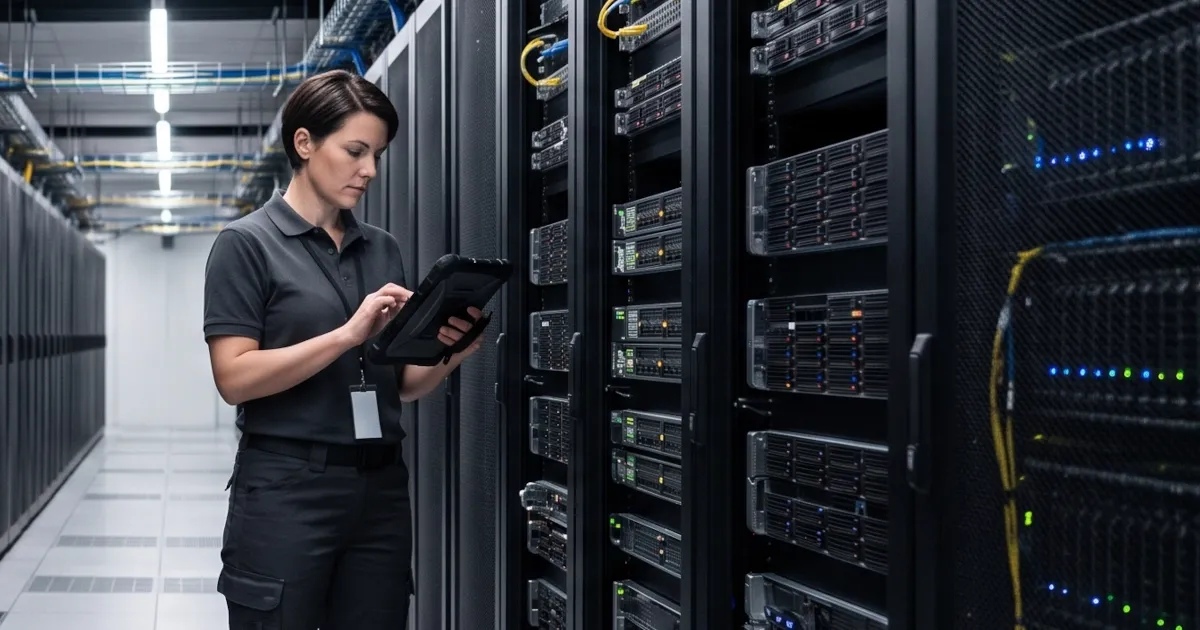
For organizations running older IBM systems, third-party hardware maintenance can also provide an alternative when equipment is approaching or has passed IBM’s standard support lifecycle.
The important question is not simply:
How old is our iSeries?
It is:
Does the system still meet our needs, and can we support it reliably while we decide what comes next?
If the answer is yes, you may have more options than replacing it.
What Does IBM iSeries Support Actually Mean?
"IBM iSeries support" can mean several different things, and knowing which type you need is important before evaluating providers.
The terminology itself can be confusing. AS/400, iSeries, System i, IBM i, and IBM Power represent different generations and elements of the same broader platform lineage.
Today, someone searching for iSeries support services could be looking for:
| What you need | What it typically includes | Where third-party maintenance fits |
|---|---|---|
| Hardware support | Failed components, replacement parts, diagnostics, field service | Strong fit |
| Preventive hardware maintenance | Keeping aging equipment operational and reducing hardware risk | Strong fit |
| IBM i operating system support | OS issues, updates, licensing and software-related support | Different from hardware maintenance |
| Application support | RPG, COBOL, DB2 applications or custom business software | Typically handled separately |
| Migration or modernization | Moving applications or workloads to newer platforms | Often a separate project |
For organizations specifically concerned about the physical server, storage, components, parts availability, or an expiring OEM maintenance agreement, third-party IBM hardware support is often the relevant category.
Is IBM iSeries Still Supported?
It depends on the specific machine type, model, operating system version, and type of support you need.
Some older AS/400 and iSeries hardware has been outside standard IBM support for years, while newer IBM Power systems continue to move through IBM’s normal product lifecycle.
For example, IBM ended standard support for several widely deployed POWER9 systems, including the 9009-41A S914, 9009-22A S922, and 9009-42A S924, on January 31, 2026.
But an IBM end-of-support date does not necessarily mean the hardware has stopped doing its job.
And it does not automatically mean the business is ready to replace it.
This is where the gap between an OEM lifecycle and a business lifecycle becomes important.
ReluTech Analysis: For Every IBM i Organization Planning to Leave, 24 Are Staying
24:1
For every IBM i organization planning to completely migrate off the platform within the next two years, roughly 24 are not.
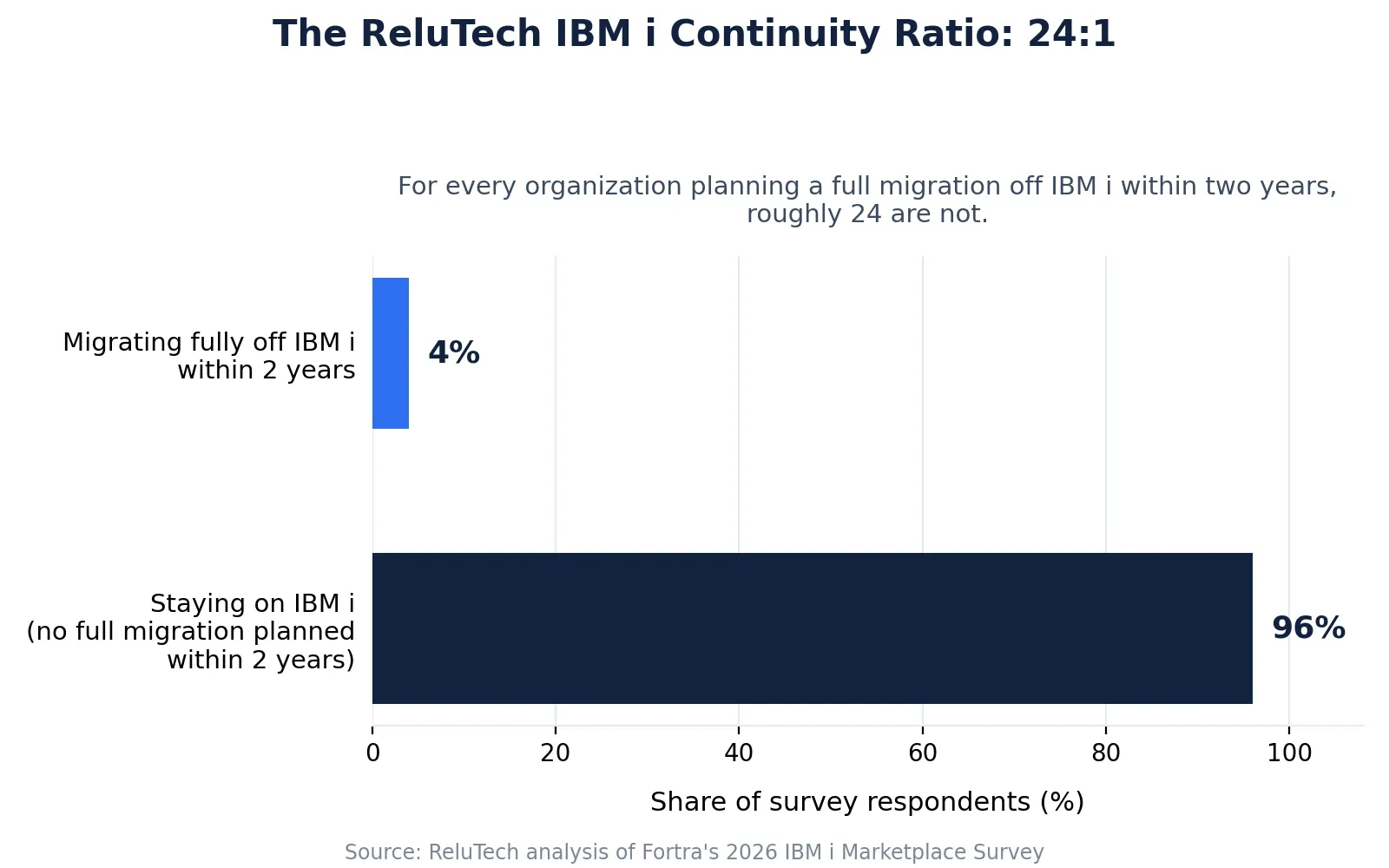
That’s the ReluTech IBM i Continuity Ratio, calculated using results from the 2026 IBM i Marketplace Survey.
Only about 4% of survey respondents reported plans to migrate all of their applications off IBM i within two years.
Put another way, approximately 96% are not planning a complete near-term exit.
That creates an important disconnect.
At the same time that organizations continue relying on IBM i, older IBM Power hardware is reaching OEM support milestones.
The result is a problem many infrastructure teams eventually face:
The hardware support timeline can end before the business is ready to move.
And the systems involved are not necessarily insignificant legacy boxes.
The same 2026 IBM i Marketplace Survey found that roughly three-quarters of respondents still run at least half of their core business applications on IBM i, with nearly half running more than 75% of their core applications on the platform.
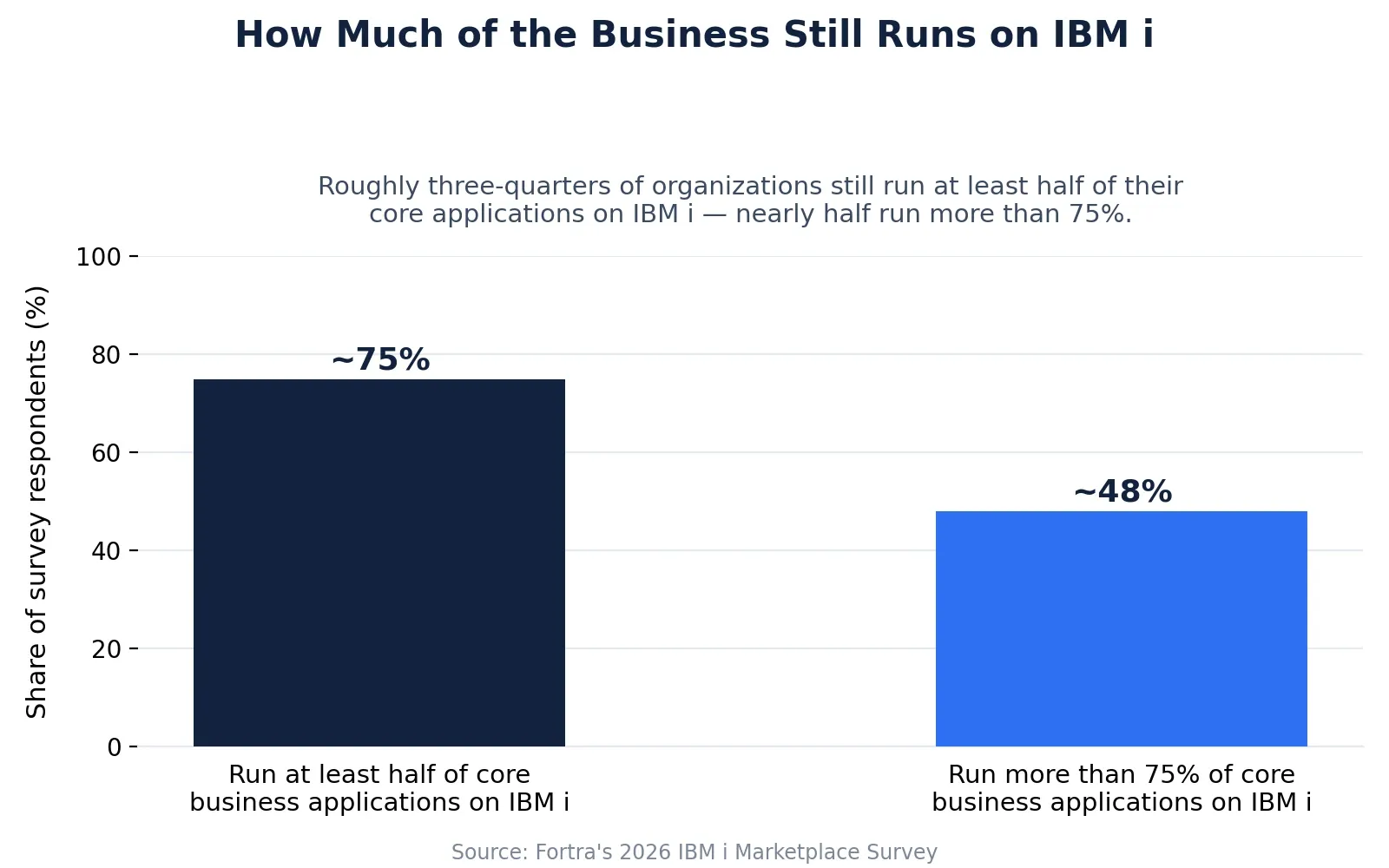
For many companies, IBM i is still running a meaningful part of the business.
So when an IBM support date arrives, the answer is not automatically "replace everything."
The better question is:
How do we keep this environment supported until the business is actually ready for what comes next?
That’s one of the primary use cases for third-party IBM iSeries support.
Instead of accelerating a hardware refresh or migration because an OEM lifecycle date arrived, organizations can evaluate whether third-party hardware maintenance can keep the existing environment covered while they modernize, migrate, budget for new infrastructure, or simply continue running a platform that still meets their needs.
Running POWER9, POWER8, iSeries, or AS/400 Hardware?
Before assuming a refresh is your only option, find out whether your existing environment can continue to be supported.
Request an IBM iSeries Support Quote
Methodology: ReluTech calculated the 24:1 IBM i Continuity Ratio using results from Fortra’s 2026 IBM i Marketplace Survey. Approximately 4% of respondents reported plans to migrate all IBM i applications within two years. 96% ÷ 4% = approximately 24. This represents ReluTech analysis of third-party survey data, not a survey conducted by ReluTech.
The Better Question: Does Your iSeries Actually Need to Be Replaced?
A support expiration and a failed server are two very different events.
If an iSeries is creating performance problems, preventing an important software upgrade, introducing unacceptable risk, or no longer meeting the requirements of the business, modernization may be justified.
But if the environment is stable and performing its intended job, the decision becomes less obvious.
Consider three things.
1. Is the System Still Meeting the Business Requirement?
Older does not automatically mean ineffective.
Many IBM i environments support mature business applications that have been refined over years or even decades. Replacing the underlying environment may introduce migration work, application dependencies, testing requirements, downtime risk, and competing demands on internal IT resources.
If there is a clear business reason to modernize, build the modernization plan.
If there is not, age by itself may not be enough reason to create one.
2. Can the Hardware Still Be Supported Reliably?
This is where AS400 maintenance and iSeries hardware support matter.
A production system is only as useful as your ability to recover when something fails.
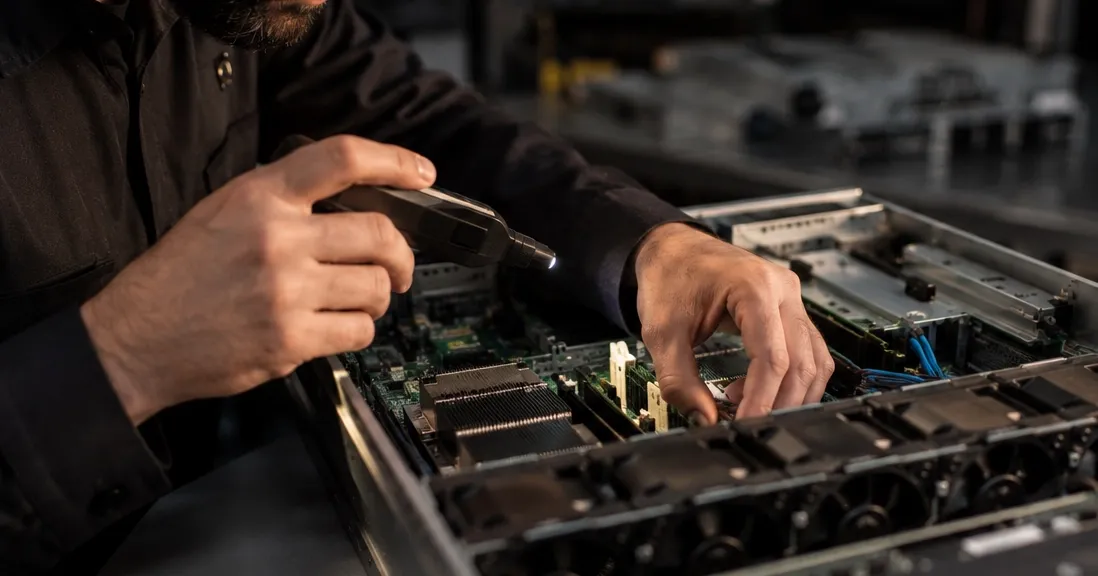
Before extending the life of an older IBM environment, determine:
- Are replacement parts available?
- Can experienced engineers support the hardware?
- What response times are available?
- Which assets and components are covered?
- What happens when a critical failure occurs?
- Does coverage extend to every location where the equipment resides?
If those requirements can be met, continued operation may be a practical option.
3. Are You Refreshing on Your Timeline or Someone Else’s?
An infrastructure refresh should ideally happen because the business is ready for it.
Maybe you are planning an application modernization initiative next year.
Maybe a cloud migration is already underway.
Maybe capital is allocated elsewhere this year.
Maybe an ERP replacement needs to happen before the underlying infrastructure changes.
Or maybe the system simply does not need to be replaced yet.
Extending hardware support can create a bridge between:
"OEM support is ending"
and
"We are actually ready to replace this environment."
That flexibility can be more valuable than forcing an infrastructure project into the wrong budget cycle.
When Third-Party IBM iSeries Support Makes Sense
Third-party maintenance is worth evaluating when your IBM hardware is stable but the existing support arrangement no longer matches your plans.
Common scenarios include:
- IBM equipment approaching or passing end of support
- Mature hardware that is still performing reliably
- An upcoming migration that makes an immediate refresh unnecessary
- Legacy applications that need to remain in production
- A modernization project that will take another 12, 24, or 36 months
- Multiple data center hardware manufacturers that you would prefer to manage under fewer maintenance contracts
- A desire to avoid investing in replacement hardware that may only be used temporarily
It can also make sense when the business wants to preserve working infrastructure while directing budget and resources toward higher-priority initiatives.
The objective is not to keep old hardware forever.
The objective is to avoid replacing productive hardware before there is a business reason to do so.
OEM Support vs. Third-Party IBM iSeries Maintenance
There is no universal answer to which support model is better. It depends on the environment and where the hardware sits in its lifecycle.
| Consideration | OEM support | Third-party maintenance |
|---|---|---|
| Current-generation equipment | Often a natural fit | May still be an option |
| Older or EOSL hardware | Coverage may change or end | Often a primary use case |
| Hardware replacement parts | OEM supply chain | Independent parts supply |
| On-site hardware service | Available by contract | Available based on SLA and provider |
| Firmware/software entitlements | Often tied to OEM agreements | Must be evaluated separately |
| Contract flexibility | Based on OEM terms | May provide more flexible coverage options |
| Multi-vendor consolidation | Usually OEM-specific | Often possible across manufacturers |
The important distinction is that third-party hardware maintenance is not automatically a replacement for IBM software support, application support, software licensing, or other entitlements.
Those requirements should be evaluated separately.
What Should IBM iSeries Hardware Support Include?
Before requesting an IBM iSeries maintenance quote, look beyond the annual price.
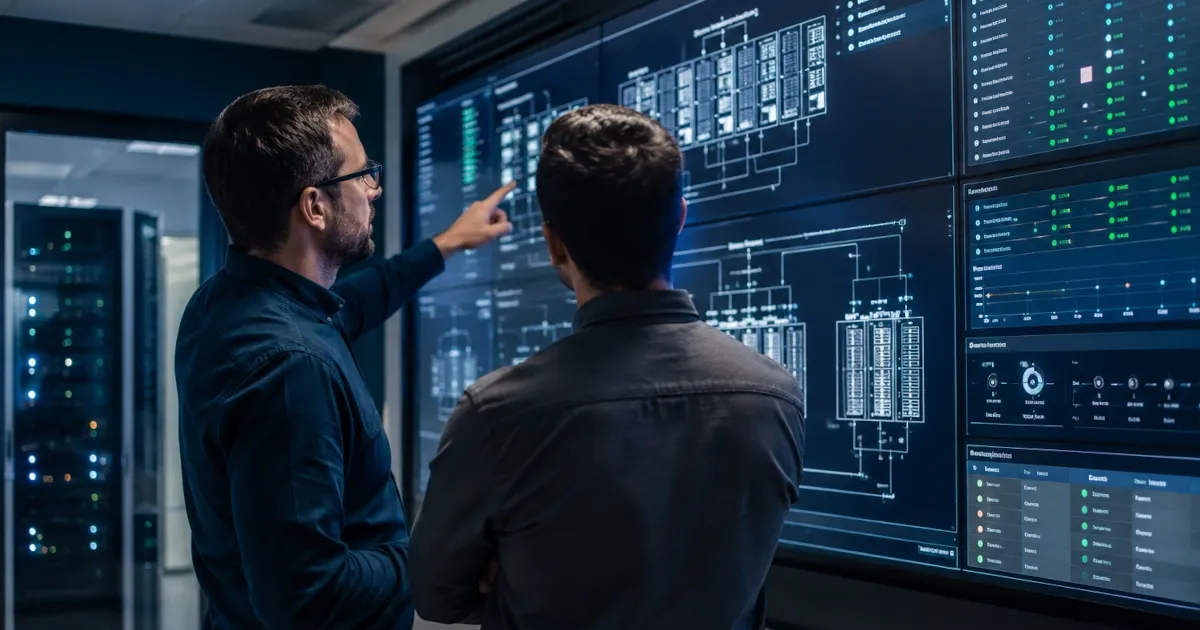
The support agreement should clearly define what happens when the system has an actual hardware problem.
Your evaluation should include:
- Remote diagnosis: Can the provider help identify the problem before dispatching parts or an engineer?
- Replacement parts: Does the provider maintain access to parts for your specific IBM machine type and model?
- Field engineering: Can an experienced technician be dispatched to your facility when remote troubleshooting is not enough?
- Response times: What service level does the workload actually require? Not every server needs the same SLA.
- Escalation: What happens when an issue cannot be resolved immediately?
- Asset-level coverage: Make sure you know exactly which servers, serial numbers, components, and locations are included.
The best support quote should therefore start with your equipment, locations, workload requirements, and acceptable response times rather than forcing every system into the same maintenance model.
What Information Do You Need for an IBM iSeries Support Quote?
You do not need a massive infrastructure assessment just to determine whether third-party support is an option.
For an initial quote, it helps to have:
- Machine type and model
- Serial number
- Physical location
- Desired service level
- Current support expiration date
If you have an existing IBM maintenance agreement, equipment schedule, or asset list, send that instead.
For larger environments, providing the complete asset list allows ReluTech to determine which systems can be covered and build the appropriate service levels around the environment.
Already have an asset list? Send it to ReluTech and request an IBM iSeries support quote.
Should You Keep Your AS400 or Replace It?
There is a relatively simple way to think about the decision.
If your platform no longer meets the technical or business requirements of the organization, develop a replacement or modernization plan.
If the system continues to meet those requirements but the support contract is driving the refresh conversation, evaluate your support alternatives before committing to replacement.
Your hardware lifecycle and your business lifecycle do not always need to be the same.
Third-party maintenance gives organizations another option.
It can provide time to plan the next move deliberately instead of making a major infrastructure decision because a support date arrived first.
IBM iSeries Support from ReluTech
ReluTech provides third-party hardware maintenance for data center infrastructure, including eligible IBM environments.
For organizations keeping existing IBM hardware in production, ReluTech can evaluate the environment, determine available coverage, and build a maintenance approach around the systems you actually need to keep running.
That may include IBM Power, iSeries, AS/400, and other eligible IBM infrastructure.
The goal is simple:
Keep the infrastructure you still need supported while giving your team control over what happens next.
Request an IBM iSeries Support Quote
If you have IBM iSeries, AS/400, System i, or IBM Power hardware that needs support, send ReluTech your equipment information or current asset list.
We’ll evaluate the environment and determine available third-party maintenance options based on your hardware, locations, and service requirements.
Request a Quote for IBM iSeries Support
Frequently Asked Questions About IBM iSeries Support
What is IBM iSeries support?
IBM iSeries support can refer to hardware maintenance, IBM i operating system support, application support, or administration services. For organizations with aging physical equipment, third-party iSeries support typically refers to hardware troubleshooting, replacement parts, remote diagnosis, and on-site service.
Is IBM iSeries the same as AS400?
They refer to different generations of the same broader technology lineage. The original AS/400 platform evolved through names including iSeries and System i. Today, IBM i is the operating system running on IBM Power servers.
Can you still get AS400 support?
Yes, depending on the specific hardware and the type of support required. Even when an older AS/400 model is no longer covered under standard OEM support, a third-party maintenance provider may be able to provide hardware support.
What is third-party IBM support?
Third-party IBM support is maintenance delivered by a provider other than IBM. For hardware, this may include remote troubleshooting, replacement parts, field engineers, and defined response-time SLAs for eligible IBM equipment.
Can third-party maintenance support IBM hardware after EOSL?
In many cases, yes. Third-party maintenance is commonly used to support eligible hardware after OEM end-of-service-life dates. Coverage depends on the specific machine type, model, location, parts availability, and required SLA.
Does third-party maintenance replace IBM i software support?
Not necessarily. Hardware maintenance, IBM i operating system support, software licensing, updates, firmware entitlements, and application support are separate considerations. Organizations should determine which services they require before changing an existing IBM agreement.
How much does IBM iSeries support cost?
The cost of IBM iSeries hardware support depends on factors such as machine type and model, number of systems, physical locations, required response time, parts requirements, and selected service level.
The most accurate way to compare options is to request coverage for your actual environment.
What do I need to request an iSeries maintenance quote?
Start with the machine type/model, serial number, equipment location, desired response time, and current support expiration date. For larger environments, an existing asset list or maintenance schedule can make quoting significantly easier.